
Capabilities
Skincare OEM manufacturing in Singapore
OEM skincare manufacturing by Celcode in Singapore: what it includes, who it suits, the process from brief to finished goods, and how quality is assured.
Skincare OEM manufacturing is a service in which a manufacturer develops and produces skincare products that are sold under a client's brand. At Celcode, OEM covers the whole chain in one Singapore site - formulation (custom or from our range), sampling, stability and regulatory checks, packaging, production under an HSA GMP-certified quality system, and release of finished goods - so a brand can go from brief to compliant, production-ready product with one partner.
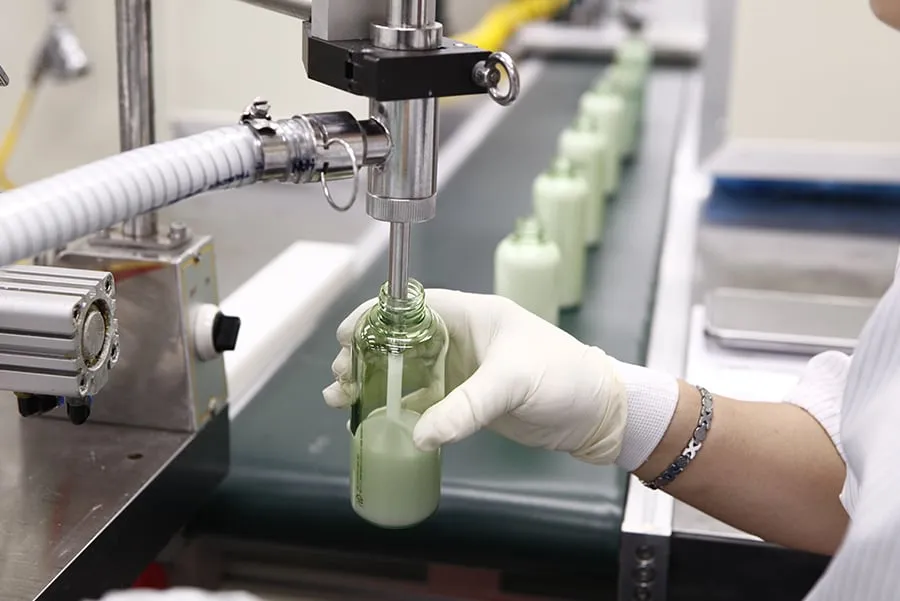
What OEM skincare manufacturing includes
An OEM arrangement makes Celcode the manufacturer of record for products that carry your brand. Depending on where you start, the service covers:
| Stage | What Celcode does | What you decide |
|---|---|---|
| Concept | Defines the product’s unique selling point, target customer, claims and business parameters with you | Brand positioning, price point, target market, launch date |
| Formulation | Develops a custom formulation, or adapts a ready formulation from our range | Development route, ingredient preferences, free-from requirements |
| Sampling and testing | Produces samples, refines them with your feedback, runs stability and shelf-life checks | Texture, colour, fragrance, final approval of the benchmark sample |
| Packaging | Selects and tests primary and secondary packaging for compatibility, supports design and labelling | Packaging format, artwork, label copy |
| Regulatory | Prepares the documentation for cosmetic product notification in Singapore and target markets | Which markets to notify; the brand is the party that places the product on the market |
| Manufacturing | Produces, fills, packs and labels under the HSA GMP-certified quality system | Order quantity and delivery schedule |
| Release and delivery | Quality-controls, releases, stores and delivers finished goods | Delivery address and logistics preferences |
The same team handles every stage at one address in Geylang, so a change agreed in a sampling meeting goes straight to the chemist who makes it.
Who it is for
- Skincare brands launching a first range or extending an existing one, including brands moving manufacturing from overseas to Singapore for shorter development cycles.
- Aesthetic clinics and medical practices that want a clinic-branded retail range or professional-strength formulations for use in treatments.
- Salons and spas that need professional treatment products and retail ranges under their own name.
- Wellness and lifestyle brands adding skincare or haircare to an existing product line.
The industries pages describe what each group typically needs.
Two routes into OEM: custom or ready formulation
Custom formulation. The product is built around your brief. Celcode’s chemists select the base and the actives, and the formula is developed, sampled and tested for your brand. This route gives the most differentiation and takes longer, because sampling rounds and stability checks are part of the work. See custom formulation.
Ready formulation. You start from an approved formulation in Celcode’s range and adapt what your brand needs - typically fragrance, colour, texture adjustments, packaging and branding. This is the faster route and the basis of private label skincare.
Most projects mix the two: a hero product developed as a custom formulation alongside supporting products adapted from the range.
Products manufactured under OEM
Celcode’s site is certified to manufacture cosmetic products as external liquid and semi-solid preparations. In practice that covers cleansers and make-up removers, toners and essences, serums and ampoules, creams, emulsions and moisturisers, masks, exfoliators and peels, professional treatment products and hair and scalp care. Products can be built on mousse, lotion, gel, serum or cream bases; the textures and formats page explains the differences.
Customisation
Within a brief, Celcode can adjust or specify:
- Actives and their levels, drawn from an in-house inventory and from suppliers worldwide, with a focus on the four factors that guide our R&D: efficiency, penetration, absorption and uniqueness.
- Texture and sensory profile: base type, viscosity, finish, fragrance and colour.
- Formulation attributes: paraben-free, sulfate-free (SLS/SLES-free), phthalate-free, free from drying alcohol, cruelty-free, vegan-friendly or suitable for Halal consumers, confirmed per formulation.
- Packaging format and decoration, with compatibility checked against the formulation.
Testing and quality
Formulations are tested for stability and shelf life during development, and samples are refined until the benchmark sample is agreed. Production then runs under a quality system audited by the Health Sciences Authority against its GMP guidelines for cosmetic manufacturers, which covers receipt of materials, production, packaging, labelling, quality control, release, storage and distribution. The testing and quality control pages describe the checks; the certifications page publishes the certificate in full.
Packaging
Primary packaging (the container in contact with the product) and secondary packaging (cartons, sleeves, inserts) are selected with the formulation in mind: a water-light serum, an aerated cream and a scalp tonic do not suit the same closure. Celcode can work from your packaging and artwork or support design and branding. See packaging and branding.
Regulatory
Every cosmetic product sold in Singapore must be notified to the Health Sciences Authority before it is placed on the market, and it must comply with the ASEAN Cosmetic Directive on ingredients, labelling and claims. Celcode prepares the technical documentation and checks the formulation and label against these requirements; the brand, as the party placing the product on the market, submits the notification. For other markets, Celcode provides the manufacturing documentation their authorities ask for. See regulatory support.
Minimum order quantities and timelines
Minimum order quantities are confirmed per product in your proposal. They depend on the development route, the packaging and the batch size. Celcode sets its minimums for small-batch launches, lower than the 5,000-unit minimums that are common with offshore manufacturers.
Timelines are set out in the development plan for your project. A ready formulation with existing packaging moves fastest; a custom formulation adds sampling rounds and stability checks before production is scheduled.
Why manufacture in Singapore
- One site for lab and factory. Consultations can be held in person, and revisions during development do not wait on overseas shipping.
- A certified quality system. GMP certification from the HSA is recognised by many export markets as evidence that a product was made under a controlled system.
- Regulatory familiarity. Celcode works within the ASEAN Cosmetic Directive daily, which shortens the path to notification in Singapore and neighbouring markets.
- Small-batch launches. Minimums are set for brands that want to test a product before committing to large runs.
How to start
Send a product brief. It asks what you want to make, the development route, the quantity you are planning, the market, the timeline and your business stage. A member of the Celcode team reviews every brief and replies by email with questions, options and next steps.
Frequently asked questions
What is the difference between OEM, ODM and private label skincare?
OEM (original equipment manufacturing) means the manufacturer produces a product to the brand's specification, which at Celcode usually starts with a custom formulation. ODM (original design manufacturing) means the manufacturer supplies its own designed product for the brand to sell. Private label is the retail form of ODM - a ready formulation sold under the brand's name. Celcode offers both routes and helps you choose based on differentiation, budget and time to market.
Do I need my own formula to start?
No. You can start from a concept and a target customer, and Celcode's R&D team will develop the formulation, or you can begin from a ready formulation in our range and adapt it. If you already have a formula or an existing product, we can reformulate or scale it.
Is Celcode GMP-certified?
Yes. Celcode Dermal Lab holds Health Sciences Authority GMP certificate MCGM2500160 for the manufacture of cosmetic products as external liquid and semi-solid preparations, valid from 29 July 2024 to 28 July 2027. Full details are on the certifications page.
Can Celcode manufacture for markets outside Singapore?
Yes. Products are manufactured to comply with the ASEAN Cosmetic Directive, and Celcode prepares documentation for cosmetic product notification in Singapore and for the requirements of target markets. Confirm the markets in your brief so ingredient and labelling rules are checked early.
What is the minimum order quantity?
Minimum order quantities are confirmed per product in the proposal, because they depend on the development route, packaging and batch size. Celcode sets its minimums for small-batch launches, lower than the 5,000-unit minimums common with offshore manufacturers.
- Written by
- Celcode Dermal Lab
- Published
- Updated